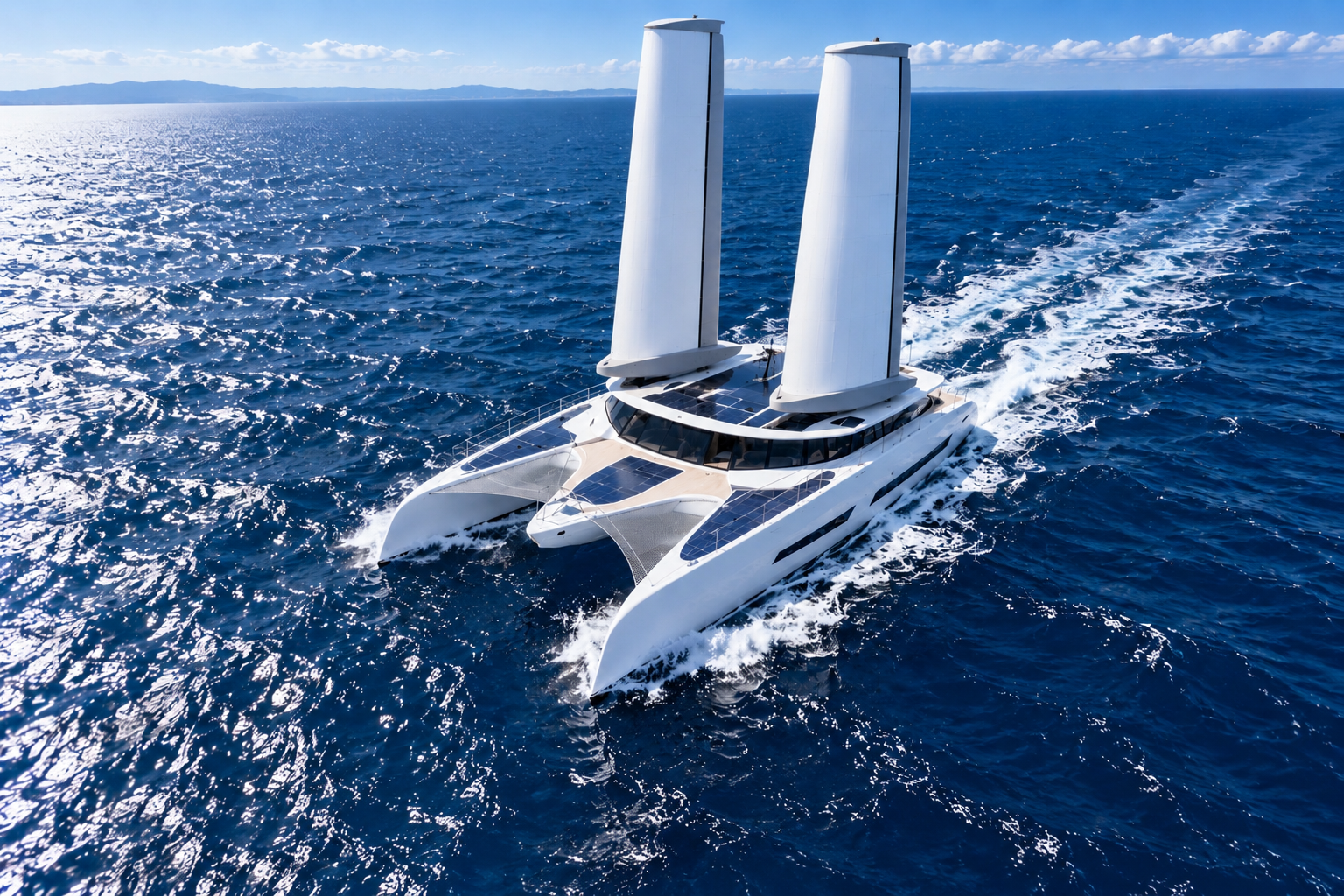
The MODX 70 combines inflatable wing sails, telescopic masts, electric propulsion, solar power and hydrogeneration in a 21.3-metre catamaran designed to produce much of its own energy while underway.
The MODX 70 is one of the more unusual attempts to rethink the modern cruising catamaran. Designed by VPLP and built by Océan Développement in France, the 21.3-metre catamaran combines inflatable wing sails, telescopic masts, electric propulsion, solar power and hydrogeneration in a yacht designed to operate without conventional fossil-fuel propulsion.
Rather than simply replacing diesel engines with electric motors, the designers approached the yacht as an integrated energy system: wind provides the primary propulsion, while solar panels and the propellers themselves generate electricity to replenish the battery bank.
Inflatable Wings Instead of Conventional Sails
The most striking feature is the two Aeroforce AF125 wings, each with an area of approximately 125 m². Instead of a conventional mast, mainsail, boom and headsail, each hull carries its own inflatable aerodynamic wing. (VPLP Design)
Although they look very different from normal sails, the principle is similar to an aircraft wing. Air flowing around the curved profile creates a pressure difference between the two sides, producing lift. On a yacht, this aerodynamic force is directed partly forward and drives the boat through the water.
The wing uses a thick NACA-style aerodynamic profile, maintained by an inflatable fabric envelope. Because the shape is more controlled than that of a conventional soft sail, it can produce efficient lift without relying on dozens of ropes, winches and sail controls.
The Flap
At the trailing edge of each wing is a controllable flap, working somewhat like the flap on an aircraft wing. Changing the flap angle changes the airflow around the wing and therefore the amount of lift produced. More flap can increase lift when extra power is required, while reducing the flap allows the wing to operate more efficiently when conditions change. The wing and flap positions are automatically controlled according to wind conditions rather than requiring the crew to constantly trim conventional sails.
A Mast That Disappears
Perhaps even more remarkable is what happens when the yacht stops sailing. Each wing is carried on a motorised telescopic carbon-fibre mast. When the wing is deployed, the mast extends upward as the inflatable wing takes its aerodynamic shape. When it is no longer required, the wing deflates and the mast telescopes downward. The wing is stored around its supporting structure rather than requiring the crew to lower and fold a huge conventional sail. The entire process is highly automated, including deployment, reefing, retraction, wing orientation and flap control. This makes it possible to handle a very powerful sail plan with a comparatively small crew.
Electric Propulsion
When there is insufficient wind, manoeuvring in harbour or when additional propulsion is required, the MODX 70 uses electric motors. The installed propulsion system provides approximately 80 kW of total electric propulsion power. It can also be described as two 40 kW propulsion groups, with the current installation using four 20 kW electric motors. The large battery system provides roughly 250 kWh of stored energy, depending on the configuration and development stage of the yacht. Electric motors also have an important advantage for manoeuvring: torque is available immediately, without waiting for an engine to increase RPM. But the electric motors are only one part of the yacht's energy system.
Solar Power
Approximately 70 m² of solar panels are integrated into the yacht's structure. Together they can produce around 15 kWp under favourable conditions. The electricity is used both for onboard systems and for replenishing the main battery bank. Solar alone cannot continuously provide enough energy for high-power motor propulsion, but sailing changes the equation completely. When the wind is driving the yacht, very little propulsion energy needs to come from the batteries. Solar production can therefore be directed toward hotel loads and battery charging.
Hydrogeneration While Sailing
The propulsion system can also work in reverse. When the yacht is sailing under its wings, water flowing past the propellers turns them. Instead of consuming electricity, the electric propulsion motors operate as generators and return energy to the batteries. MODX quotes approximately 3–10 kW of hydrogeneration depending on boat speed, with some later technical material indicating that higher output may be achievable under favourable conditions.
This creates an interesting cycle: Wind drives the yacht → the propellers rotate → electricity is generated → the batteries recharge.
At the same time, solar panels continue producing electricity. This combination of wind, solar power and hydrogeneration is what makes the MODX concept particularly interesting for long-distance cruising.
Performance
The unusual wings are not intended only to save energy. They can also produce considerable sailing performance. The yacht has reportedly reached around 22 knots during sailing trials, although normal cruising is deliberately kept lower to reduce loads and maintain comfort. Around 15–20 knots of true wind appears to be a particularly effective operating range for the wing system. (Boat International Stories)
Despite the advanced technology, the MODX 70 is not conceived as a stripped-out racing prototype. It remains a large cruising catamaran with extensive living areas and owner or charter accommodation arrangements.
A Different Vision of Cruising
The significance of the MODX 70 is not any single component. Electric propulsion already exists. Solar-powered yachts exist. Wing sails have been tested before, and hydrogeneration is common on modern offshore sailing yachts. What makes the MODX 70 unusual is that all these technologies were designed to work together from the beginning. Its inflatable wings provide the main propulsion. The electric motors provide backup and manoeuvring capability. Solar panels produce electricity whenever sunlight is available, while hydrogeneration converts some of the yacht's sailing speed back into electrical energy. The result is an interesting glimpse of what future long-range cruising yachts may look like: not necessarily yachts carrying ever larger batteries, but vessels designed to produce much of their own energy while underway.
Official MODX Links
MODX Catamarans – main website: modx-catamarans.com/en. Aeroforce inflatable and retractable wing technology: modx-catamarans.com/en/aeroforce.
Videos
MODX 70 – official video: modx-catamarans.com/en/photos-and-videos. MODX 70 – Multihulls World: youtube.com/watch?v=TvllU3MycF8. Aeroforce wing technology: youtube.com/watch?v=9gBw97Qgf40.