Vendée Globe – The Ultimate Solo Sailing Challenge
Captain's Corner Magazine · 5 October 2026
The Vendée Globe is widely regarded as one of the toughest and most prestigious challenges in sailing. Competitors race alone, non-stop and without outside physical assistance around the world, starting and finishing at Les Sables-d'Olonne on France's Atlantic coast.
The course takes sailors down the Atlantic, around the Cape of Good Hope, across the Southern Ocean past Cape Leeuwin, around Cape Horn, and finally back north through the Atlantic. Although the theoretical route is roughly 24,000 nautical miles, competitors usually sail considerably farther while searching for favourable weather. Known as the ‘Everest of the Seas,’ the Vendée Globe tests not only sailing ability but endurance, engineering knowledge, navigation, decision-making and survival skills.
From a Crazy Idea to a Legendary Race
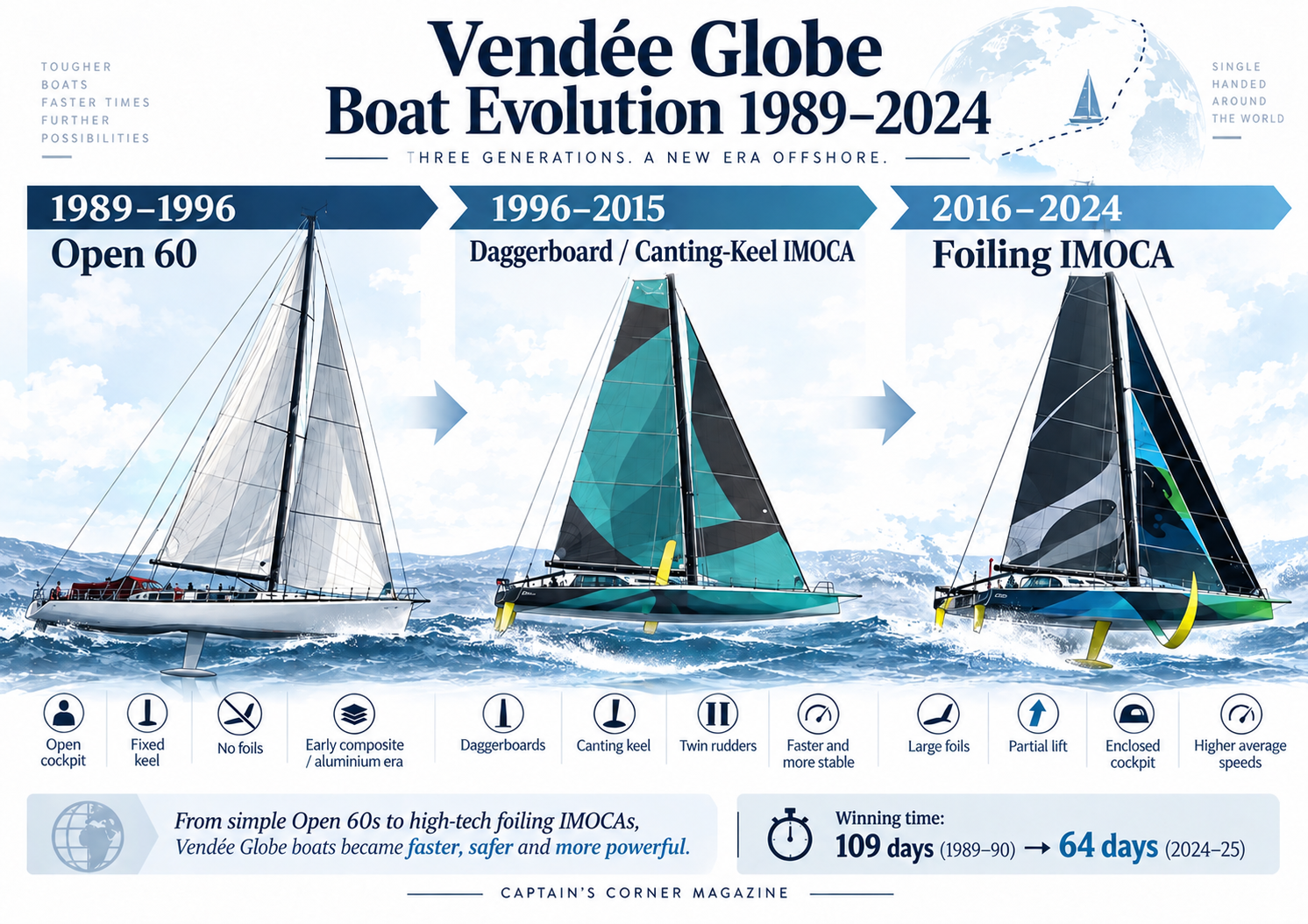
The Vendée Globe was inspired partly by the 1968–69 Sunday Times Golden Globe Race, the first solo non-stop round-the-world sailing competition. Only Robin Knox-Johnston completed that race. French sailor Philippe Jeantot, twice winner of the BOC Challenge round-the-world race with stopovers, developed an even more extreme concept: sail around the planet alone without stopping. The first Vendée Globe started on 26 November 1989 with 13 competitors. Only seven were classified as finishers. Titouan Lamazou won the inaugural race in 109 days, 8 hours and 48 minutes. Since then, the race has been held approximately every four years while maintaining its fundamental philosophy: one sailor, one boat, around the world, without stopping.
Faster Boats, Faster Circumnavigations
Few statistics demonstrate the evolution of the Vendée Globe better than winning times.
The first race required 109 days. Michel Desjoyeaux broke the 100-day barrier in 2000-01, finishing in approximately 93 days. François Gabart reduced the record to 78 days in 2012-13, followed by Armel Le Cléac'h at just over 74 days in 2016-17. In the 2024-25 Vendée Globe, Charlie Dalin produced an extraordinary new record of: 64 days, 19 hours and 22 minutes. Compared with the first Vendée Globe, the winning time has fallen by roughly 45 days, or around 41 percent. This improvement comes from better yacht design, construction materials, foils, sails, weather forecasting and autopilot technology. However, weather remains decisive, meaning that newer boats do not automatically produce faster editions.
Evolution of the IMOCA 60
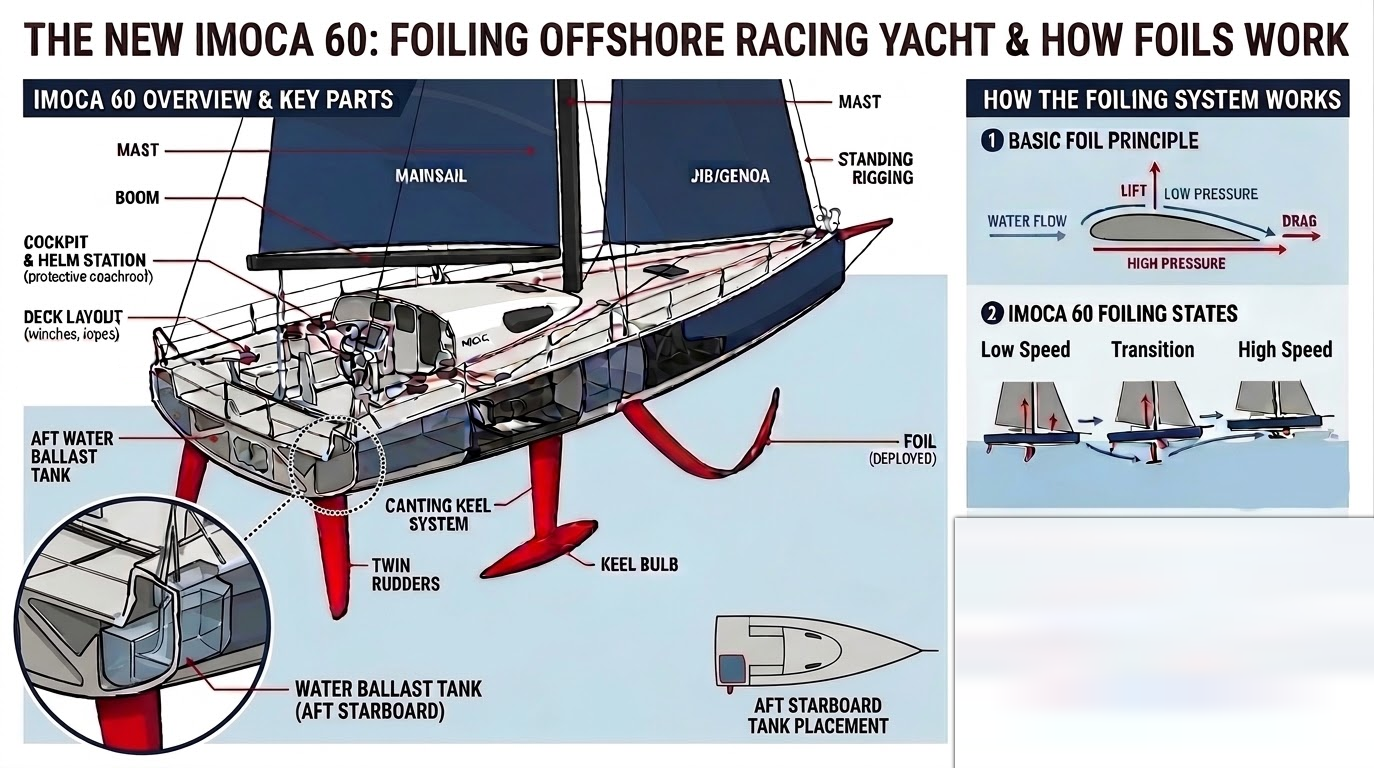
Vendée Globe yachts belong to the IMOCA 60 class. They remain approximately 18.28 metres — 60 feet — long, but almost everything else has changed dramatically. Early boats were relatively simple Open 60 designs. During the 1990s, aluminium increasingly gave way to lightweight carbon-composite construction, while hulls became wider and more powerful. The introduction of canting keels was another major development. Instead of remaining vertically beneath the hull, the keel can swing to windward, increasing righting moment and allowing the boat to carry more sail.
The disastrous 1996–97 Vendée Globe, during which several yachts capsized, led to major improvements in stability and safety regulations. Modern IMOCA yachts must meet strict stability, watertight compartmentation and self-righting requirements.
By the 2000s, sophisticated autopilots, satellite communications, computer-based weather routing, advanced sail systems and stronger composite structures had transformed the class.
The Foiling Revolution
Perhaps the greatest modern breakthrough came with foils, first introduced to new IMOCA designs around 2015. Large curved foils project from the sides of the hull and generate both lateral force and vertical lift. By partially lifting the yacht, they reduce drag and allow dramatically higher speeds. The 2016–17 Vendée Globe proved their potential when foil-equipped boats dominated the front of the fleet. Modern IMOCAs combine enormous foils with canting keels, wide sterns, powerful hull shapes and increasingly enclosed cockpits. In favourable conditions, they can approach 40 knots. During the 2024–25 Vendée Globe, Sébastien Simon covered more than 615 nautical miles in 24 hours, averaging around 25.6 knots for an entire day.
Why Is the Vendée Globe So Difficult?
Despite all the technology, there is still only one person aboard. The skipper must simultaneously act as captain, navigator, meteorologist, mechanic, electrician, sailmaker, rigger and sometimes doctor. When something breaks, there is no engineer available to repair it. Sailors have repaired damaged sails, rebuilt steering systems and even climbed their masts alone in severe seas. Sleep is another major challenge. Competitors cannot simply sleep for eight uninterrupted hours while travelling at 20–30 knots. Instead, they normally rely on short sleeping periods while alarms and electronic systems monitor the boat. The greatest danger is often the Southern Ocean, where competitors can be thousands of kilometres from land while encountering powerful low-pressure systems, huge seas, cold temperatures and possible ice. The combination of extreme speed, isolation, fatigue, technical complexity and months of continuous competition gives the Vendée Globe its unique reputation.
Accidents, Rescues and Extraordinary Survival Stories
The history of the Vendée Globe includes some of ocean racing's most dramatic rescues.
During the first race, Philippe Poupon's yacht capsized, and fellow competitor Loïck Peyron diverted to assist him. The 1996–97 edition became one of the darkest in the race's history. Raphaël Dinelli capsized in the Southern Ocean and was rescued by British sailor Pete Goss, who turned his boat around and fought through severe conditions to reach him. Tony Bullimore survived for days inside his overturned yacht before being rescued by the Australian Navy. Canadian sailor Gerry Roufs disappeared at sea.
In 2000-01, Yves Parlier lost his mast in the Southern Ocean. Rather than abandoning, he anchored near Stewart Island, constructed a jury rig himself and continued around the world. During the 2008–09 race, Yann Eliès broke his femur and pelvis approximately 800 miles south of Australia and had to await evacuation by the Australian Navy. That same race saw Jean Le Cam capsize near Cape Horn. Vincent Riou diverted and successfully rescued him from the overturned yacht.
One of the most remarkable modern rescues occurred in 2020, when Kevin Escoffier's IMOCA PRB suddenly broke apart southwest of the Cape of Good Hope. Escoffier had only minutes to enter his liferaft. Jean Le Cam eventually found him after hours of searching in darkness and difficult conditions. Several competitors abandoned their own racing to participate in the rescue operation. They later received time compensation — a decision that ultimately helped determine the winner of the race. It demonstrated one of offshore sailing's most important traditions: when a life is at risk, racing becomes secondary.
A Race Where Finishing Is an Achievement
The Vendée Globe has become progressively safer and more professional, but simply finishing remains a major achievement. Across the first ten editions there were around 240 starts but only 146 classified finishes. The 2024–25 race showed how far reliability has progressed: 40 sailors started and 32 finished — an 80 percent completion rate, the highest proportion in the race's history. Michel Desjoyeaux remains the only sailor to have won twice, while women have also achieved important milestones. Catherine Chabaud became the first woman to complete the race, Ellen MacArthur finished second in 2000-01, and Justine Mettraux established a new women's Vendée Globe record in 2024-25.
The technology may have changed dramatically since 1989, but the essential challenge remains remarkably simple: one person, one 60-foot sailing yacht, one voyage around the world — without stopping. That combination of technology, courage, endurance and self-reliance is what continues to make the Vendée Globe one of the defining events in ocean sailing.