


Offshore Internet at Sea: Iridium, Starlink and Amazon Leo Compared
Captain's Corner Magazine · 14 October 2026
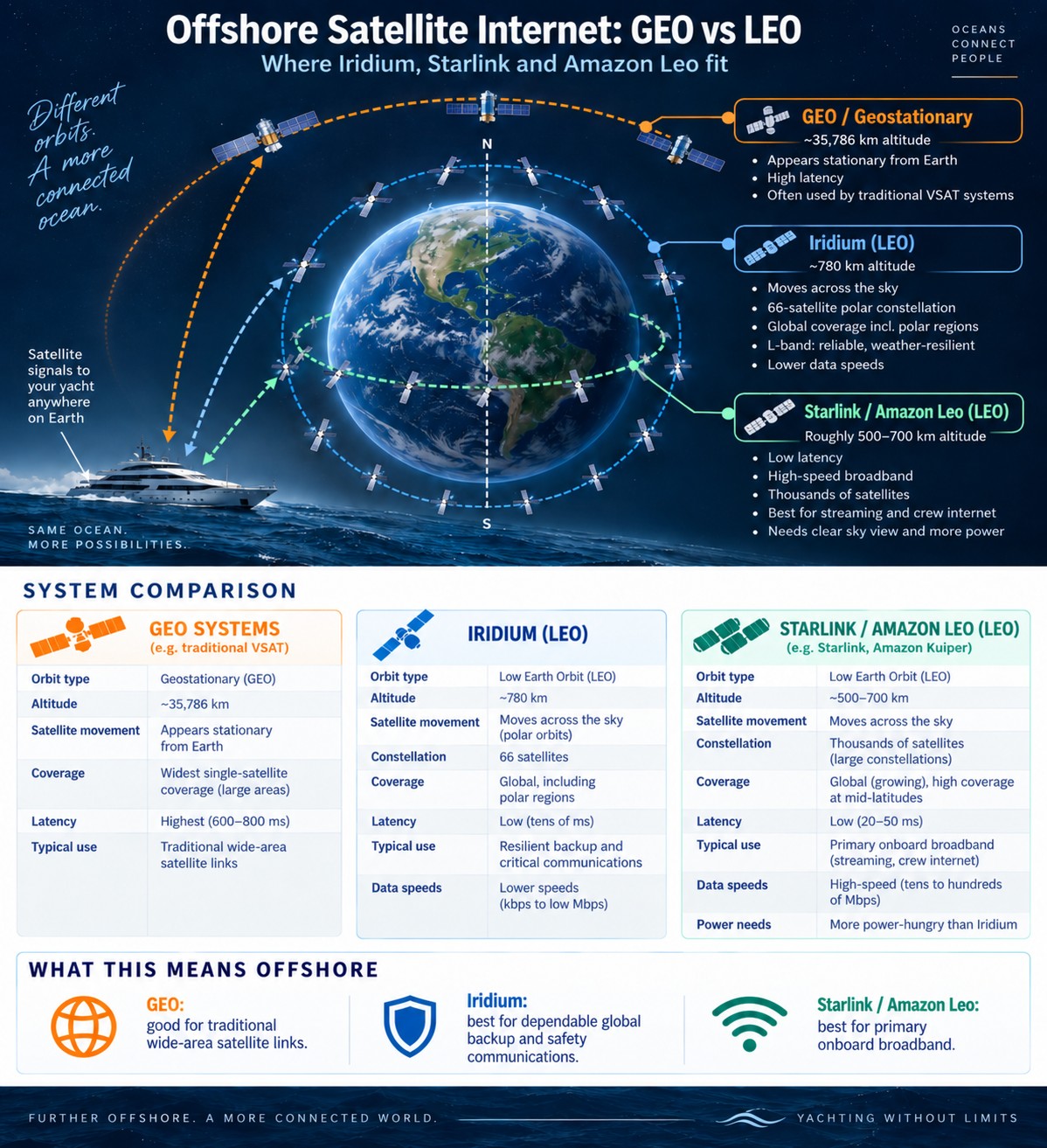
High-speed broadband for everyday connectivity, high-reliability satellite for backup and safety — how the main offshore internet options divide, and which combination makes sense.
Reliable internet offshore has changed dramatically in the last few years. Traditional satellite systems such as Iridium prioritize global coverage and reliability, while newer Low Earth Orbit broadband networks such as Starlink — and soon Amazon Leo — offer speeds approaching normal terrestrial internet. For yachts and commercial vessels, the main options divide into high-speed broadband for everyday connectivity and high-reliability satellite communications for backup and safety.
Quick Comparison
Quick comparison. Iridium GO! exec — 88 Kbps down / 22 Kbps up, hardware around US$1,569, plans from $69.95 to $209.95 per month; best for emergency backup and weather. Iridium Certus — up to 704 Kbps down / 352 Kbps up, hardware $4,500 to $8,000 and up, plans from $115 to $2,125 and up per month; best as a professional backup for ships. Starlink Maritime — typically tens to hundreds of Mbps, hardware around US$1,999, plans from $250 to $2,150 per month; best as primary yacht internet. Amazon Leo — up to around 400 Mbps, and 1 Gbps on larger terminals; hardware and subscriptions not yet publicly priced; a future high-speed alternative to Starlink.
1. Iridium GO! exec
The Iridium GO! exec is essentially the modern successor to the original Iridium GO! — sometimes informally referred to as a “GO 2.” It uses Iridium's Low Earth Orbit satellite network and the Iridium Certus 100 service. The small portable unit creates a Wi-Fi hotspot for phones, tablets and laptops and also includes Ethernet, a touchscreen, built-in speaker and microphone, GPS and an SOS function. Maximum data speed is approximately 88 Kbps download and 22 Kbps upload.
Its greatest strength is reliability. Iridium offers genuinely global coverage, including oceans and polar regions, and GO! exec consumes very little power compared with broadband systems. Its internal battery also makes it useful if the vessel loses electrical power. The weakness is speed: it is suitable for email, messaging, weather downloads and limited web access, but not normal web browsing, video conferencing or streaming. Hardware currently costs around US$1,569. Example airtime plans range from about $69.95/month for small data allowances to around $209.95/month for larger or unlimited-data packages, depending on provider and plan conditions. Best suited to: offshore sailors, smaller yachts, emergency communications and as a low-power backup to Starlink.
Iridium Certus is the professional version of Iridium broadband and is likely the service sometimes referred to as “Iridium Connect.” Certus uses permanently installed marine antennas rather than a portable unit. Depending on the terminal, Certus is available in several speed classes. Certus 200 provides up to 176 Kbps, while Certus 700 reaches approximately 704 Kbps download and 352 Kbps upload.
2. Iridium Certus
Its biggest advantage is resilience. Iridium uses L-band frequencies, which are considerably less sensitive to heavy rain and atmospheric conditions than higher-frequency satellite broadband systems. Coverage is global, including the poles, making Certus particularly useful as a backup connection to Starlink or another VSAT/LEO system. Its main disadvantage is cost per megabyte. Although far quicker than GO! exec, even Certus 700 is extremely slow compared with Starlink. Hardware prices vary considerably, typically from around $4,500 to more than $8,000 depending on terminal and installation. Example maritime plans can start near $115/month with little or no included data and rise to roughly $2,425/month or more for larger packages. Best suited to: large yachts, commercial vessels and vessels requiring a highly reliable secondary communications system.
Starlink has transformed offshore connectivity. Instead of using a small number of distant geostationary satellites, Starlink uses thousands of satellites in Low Earth Orbit, dramatically reducing latency while providing broadband speeds. The latest Starlink Performance maritime hardware is designed for permanent installation and harsh marine conditions and is capable of hundreds of Mbps, with marketed capability of 400+ Mbps under suitable conditions.
3. Starlink Maritime
This allows a yacht to use satellite internet almost like normal broadband: video calls, streaming, cloud services, remote CCTV, software updates and crew internet can operate simultaneously. The professional Starlink Performance maritime kit currently costs around US$1,999. Global Priority plans are approximately $250/month for 50 GB, $650 for 500 GB, $1,150 for 1 TB and $2,150 for 2 TB. Starlink's weaknesses are higher electrical consumption than Iridium, the need for a relatively unobstructed view of the sky, regulatory restrictions in some countries and the possibility of interruptions. It should therefore not be considered a substitute for dedicated maritime distress communications. Best suited to: the primary internet connection aboard almost any modern yacht.
Amazon Leo, formerly known as Project Kuiper, is Amazon's answer to Starlink. It is also based on a large Low Earth Orbit constellation connected through high-speed optical links between satellites. For maritime use, Amazon has announced terminals designed for roughly 400 Mbps on smaller hardware and up to about 1 Gbps download / 400 Mbps upload on larger terminals.
4. Amazon Leo
Potential strengths are very high upload speeds, low latency, integration with Amazon's AWS cloud infrastructure and, importantly, increased competition in the maritime satellite market. However, as of September 2026, Leo remains in its initial commercial rollout. The constellation is still being expanded, and publicly available maritime hardware prices and subscription tariffs have not yet been announced. Because of this, it cannot yet be evaluated on price or real-world maritime reliability as confidently as Starlink. Best suited to: potentially becoming a high-speed alternative or second broadband connection alongside Starlink once the network reaches mature commercial operation.
Rather than choosing only one system, the strongest offshore communications setup is increasingly a hybrid system. For a modern yacht, Starlink makes the most sense as the primary high-speed internet connection, while Iridium GO! exec or Iridium Certus provides an independent, low-power, truly global backup. On larger yachts, Certus is particularly attractive because the Iridium L-band network remains available when high-bandwidth systems are unavailable or degraded.
Which Combination Makes Sense Offshore?
Amazon Leo could eventually change this equation. Once commercially mature, a yacht may realistically carry Starlink + Amazon Leo for broadband diversity, with Iridium retained for critical communications and emergency redundancy. In offshore communications, maximum speed is useful — but redundancy is ultimately more important than speed.
More in Equipment
 Equipment
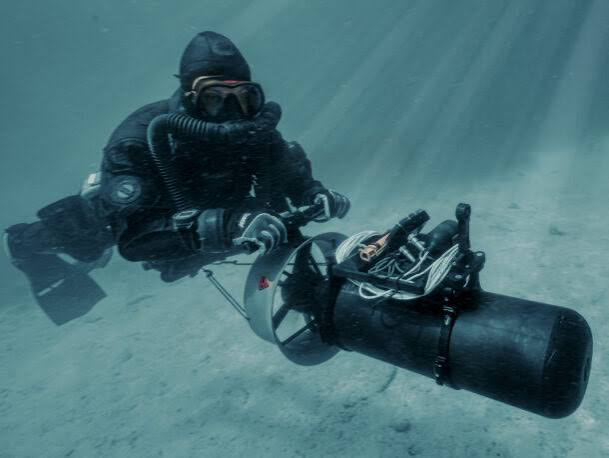
Underwater Scooters: Seven Models Compared for Yacht Use
From premium performance machines to ultra-portable travel scooters — speed, endurance, depth, storage and budget side by side.
Captain's Corner Magazine · 8 October 2026
 Equipment
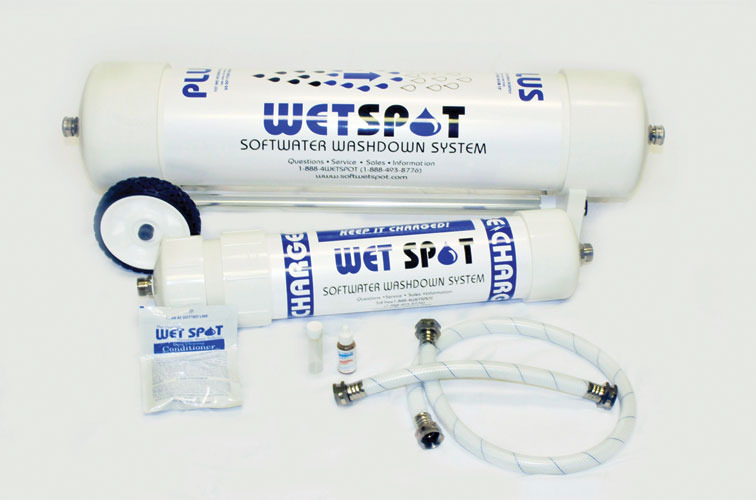
Wet Spot Water Softeners
A simple marine solution for easier washdowns and less scale in onboard freshwater systems.
Captain's Corner Magazine · 12 September 2026
 Equipment
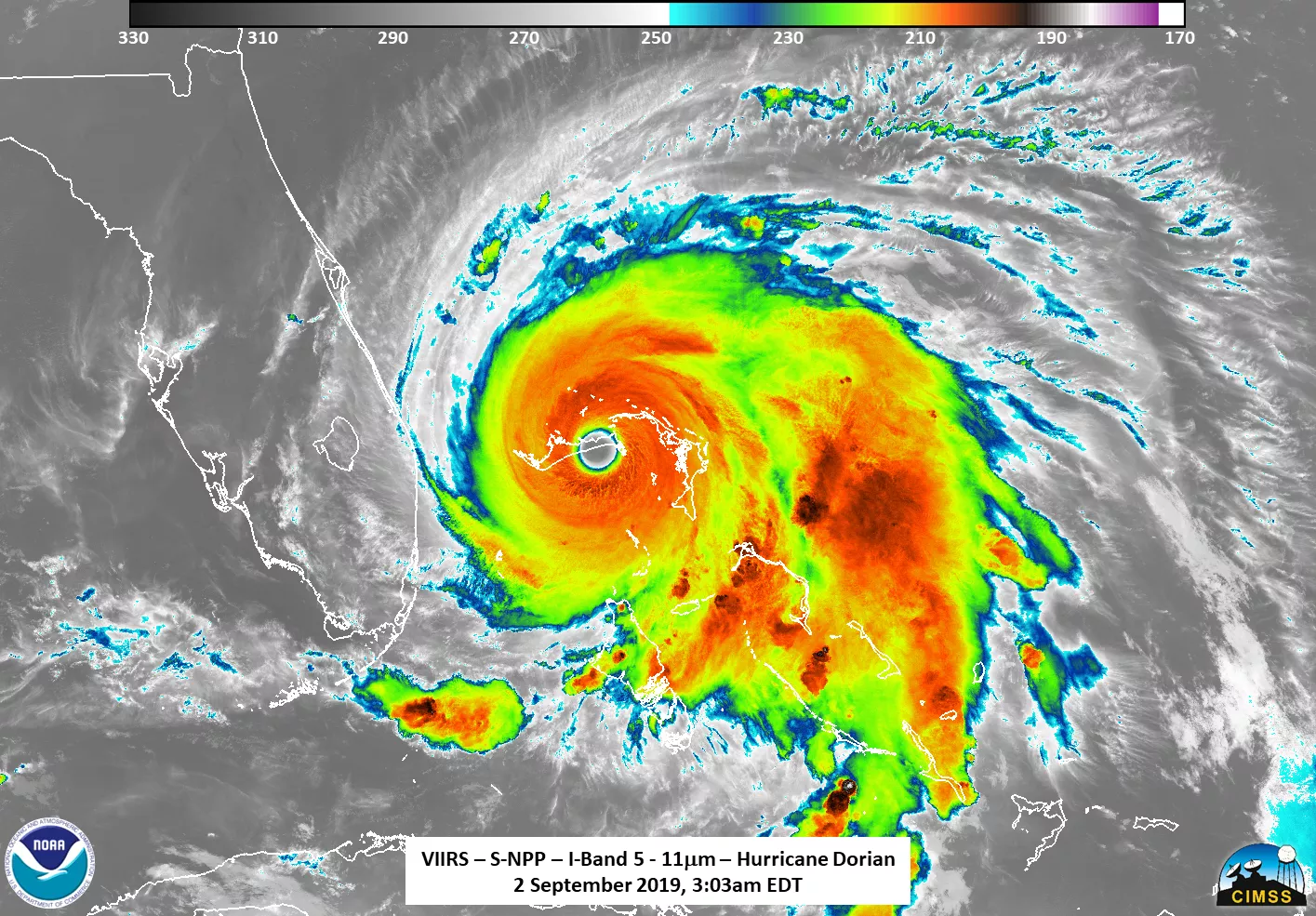
Weather Apps at Sea
Windy, PredictWind, Windfinder and Ventusky explained — which layers matter, how the models differ and how to combine forecasts, radar and satellite into one clear picture at sea.
Captain's Corner Magazine · 28 September 2026