

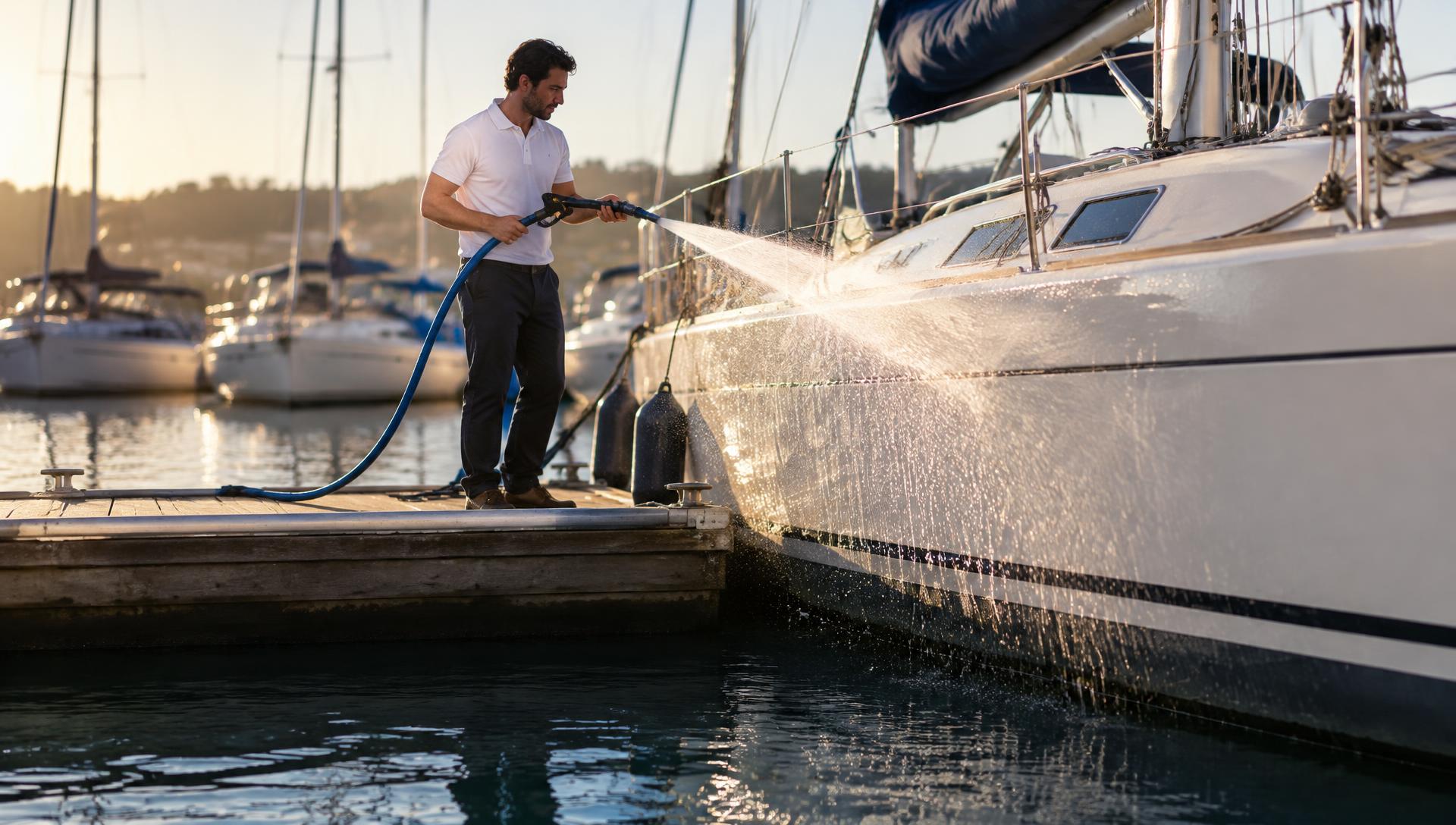
A simple marine solution for easier washdowns and less scale in onboard freshwater systems.
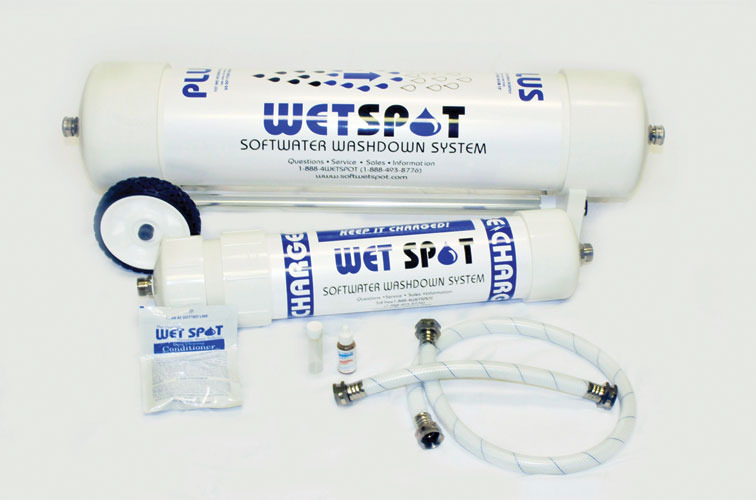
Hard marina water is a common source of white spotting and mineral scale aboard yachts. Wet Spot is a portable marine water softener designed to treat shore water before it reaches the washdown hose or freshwater tank. Its ion-exchange resin captures calcium and magnesium — the principal hardness minerals — and exchanges them for sodium ions. The unit needs no electrical supply and is regenerated manually with water-softening rock salt.
At a Glance
Technology: sodium ion-exchange resin · Power: none required · Primary use: washdown and tank filling · Models: Plus, Heavy Duty and Super · Warranty: 12 years (manufacturer) · Key limitation: softens water; does not produce zero-TDS water.
Models, sizes and current prices
Wet Spot Plus — for yachts up to 70 ft, 34 x 7.25 x 10.5 in (86 x 18 x 27 cm), 35 lb / 15.9 kg, list price $945. Wet Spot Heavy Duty — for 70-100 ft, 39 x 7.25 x 10.5 in (99 x 18 x 27 cm), 45 lb / 20.4 kg, $1,098. Wet Spot Super — for 100 ft and up, 45 x 7.25 x 10.5 in (114 x 18 x 27 cm), 50 lb / 22.7 kg, $1,198. Manufacturer U.S. list prices checked September 2026; shipping, taxes and import costs are additional.
Why it helps during washdown
The visible benefit is reduced hard-water spotting. Calcium and magnesium left after evaporation form the familiar white marks on glass, stainless steel, gelcoat and painted surfaces. By removing hardness before the hose, softened water leaves far less scale-forming residue. Soap also lathers more effectively, rinsing becomes easier and crews can spend less time chamoising and correcting mineral marks.
Benefits inside the potable-water system
The same treatment can be used when filling the freshwater tank. Reducing calcium and magnesium at the dock helps limit new scale throughout the onboard system. This can benefit tank fittings, freshwater pumps, pressure switches, pipework, faucets, shower heads, solenoid valves, coffee machines, dishwashers and water heaters. Heating surfaces are particularly prone to scale, which can reduce heat-transfer efficiency and increase cleaning requirements.
What it does well — and what it does not
What it does well: reduces calcium and magnesium hardness, reduces scale formation, improves soap performance, needs no electrical power, and can serve washdown and tank filling. What it does not do: it does not substantially reduce total dissolved solids, does not create zero-TDS rinse water, is not a disinfectant, and does not replace carbon/UV or RO where those are required.
Potable-water considerations
A softener is not a purifier. It should only be supplied with water that is already microbiologically safe, or used as one stage in a wider treatment train. Softening exchanges hardness ions for sodium, so it does not remove bacteria, viruses or the majority of other dissolved contaminants. Yachts requiring higher drinking-water quality should use appropriate sediment/carbon filtration, UV disinfection and, where necessary, RO treatment downstream or on dedicated drinking-water outlets.
Maintenance and regeneration
Maintenance is comparatively simple. The resin is periodically regenerated with water-softening rock-salt crystals. Wet Spot recommends testing the treated water with the supplied hardness kit, initially after roughly three weeks and then weekly until the crew establishes a recharge interval for the local water source and usage pattern.
The recharge routine: 1. Test hardness — use the supplied test kit and recharge before hardness returns. 2. Regenerate — fill the recharge cylinder with softening rock-salt crystals, not pellets, and backflow slowly through the main unit. 3. Allow 15-20 minutes — recharge normally takes about 15-20 minutes; Heavy Duty and Super models require the recharge cycle twice. 4. Flush and inspect — flush out residual brine, then reconnect; inspect hoses and fittings and hand-tighten connections, avoiding tools on hose fittings. Full instructions: https://softwetspot.com/wetspot-instructions/ and https://softwetspot.com/wp-content/uploads/2025/04/wetspot_instructions.pdf
Where Wet Spot fits best
For yachts regularly exposed to hard marina water, Wet Spot is a practical first-line treatment: portable, power-free and considerably simpler than RO/DI. It can reduce washdown labour and help slow mineral scale throughout the freshwater system. Its limitation is equally important: softened water is not demineralized water. Where the requirement is genuinely spot-free, near-zero-TDS rinsing, reverse osmosis followed by DI remains the more complete solution.
More in Equipment
 Equipment
Underwater Scooters: Seven Models Compared for Yacht Use
From premium performance machines to ultra-portable travel scooters — speed, endurance, depth, storage and budget side by side.
Captain's Corner Magazine · 8 October 2026
 Equipment
Offshore Internet at Sea: Iridium, Starlink and Amazon Leo Compared
High-speed broadband for everyday connectivity, high-reliability satellite for backup and safety — how the main offshore internet options divide, and which combination makes sense.
Captain's Corner Magazine · 14 October 2026
 Equipment
Weather Apps at Sea
Windy, PredictWind, Windfinder and Ventusky explained — which layers matter, how the models differ and how to combine forecasts, radar and satellite into one clear picture at sea.
Captain's Corner Magazine · 28 September 2026